

Our Impact



Our thanks to some of our National Advertisers.




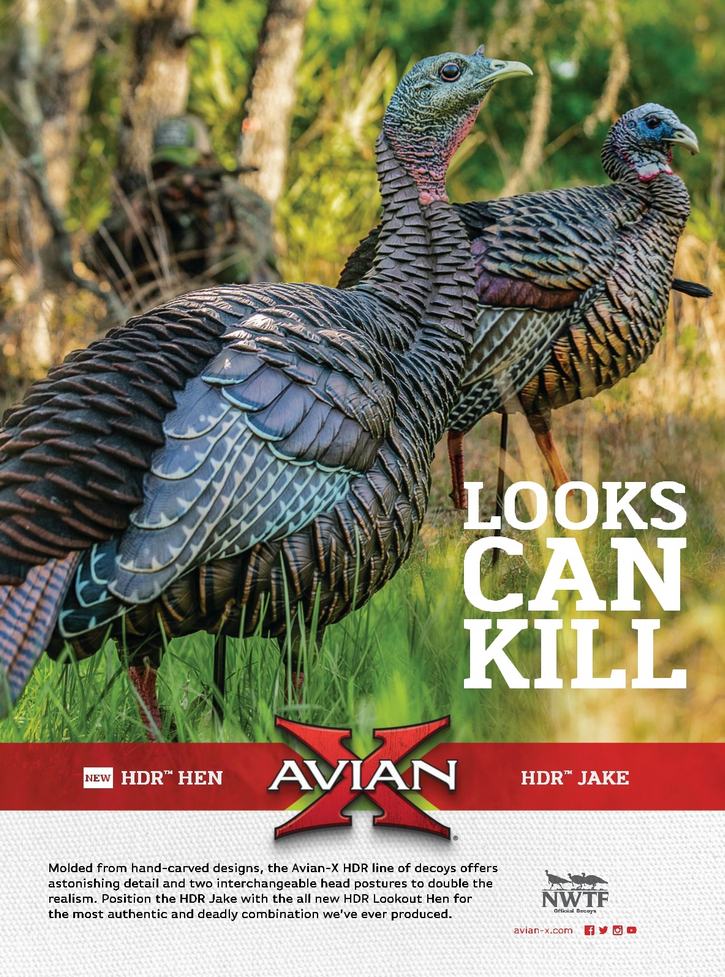

At the National Wild Turkey Federation Texas Chapter, the outdoors isn’t just what’s on the other side of the glass, it’s where we feel most alive. And we’re making Texas the best it can be for the people and wildlife who call it home.
NWTF Texas and its partners have identified the most critical areas of habitat in the state. We are actively managing that land for the future of the wild turkey.
NWTF Texas and its partners recruit hunters and conservationists through hunter education and mentored hunts.
NWTF Texas supports public hunting access through lease programs, staying current on legislative issues that impact hunter access and working with landowners to garner access for hunting.
Here are some of our recent success stories
Post Oak Savannah Restoration Project in Texas Complete

Post Oak Savannah restoration in East Texas
The NWTF and the Texas Parks and Wildlife Department recently completed a collaborative post oak savanna restoration project on the Gus Engeling Wildlife Management Area, a nearly 11,000-acre WMA purchased using Pittman-Robertson funds, in northwest Anderson County, Texas.
Post Oak Savannah habitats in Texas are a dwindling ecoregion found in the eastern part of the state and are comprised of thick grasses and forbes interspersed with oak species, making great forage and brood habitat for wild turkeys.
The project began in 2015 on a 2,000-acre section of the WMA with the removal of undesirable upland hardwood species, including post oak, blackjack oak, sandjack oak and black hickory. This reduction of the basal area (density of trees) through logging efforts allowed more sunlight to reach the forest floor, returning the post oak savanna ecoregion back to a more natural state and promoting beneficial habitat for wild turkeys and countless other wildlife.
The project also sold the marketable timber for more than $137,000, funds the NWTF held in a stewardship contract to be used for on-the-ground habitat management work that will maintain post oak savanna restoration efforts.
“We used those funds to do service work on the WMA by creating 3.4 miles of 75-foot-wide fire lines, conducting an herbicide treatment on 1,661 acres and promoting the use of prescribed burning,” said Annie Farrell, NWTF District Biologist.


“The NWTF has helped facilitate multiple wild turkey releases on the Gus Engeling WMA, and several NWTF chapters have held numerous wildlife field days for you there, too,” Farrell said. “Texas Parks and Wildlife Department continues to use the WMA as a demonstration area for Post Oak Savannah restoration.”
NWTF Texas Save the Habitat. Save The Hunt.
NWTF’s national habitat and hunting heritage initiative continues to move forward in the Lone Star State with habitat acres accruing in some of your NWTF Focal Landscapes and beyond from west to east, and north to south. Since 2014, we have enhanced or conserved over 100,037 acres of habitat on public and private lands through state and federal partnerships. As well, public access has been opened in Texas on 93,278 acres for that same time period with our assistance through hiring of three NWTF Private Lands Leasing Biologists for TPWD. UPDATE: TPWD has applied for new Voluntary Public Access Program money from USDA and if successful, will sign a new agreement with NWTF to host another new Private Land Leasing Biologist position (one) in Texas for ~3-4 years which would start on September 1st, 2020.
Lake Ray Roberts Public Hunting Land Access Projects
We completed additional hunter access projects in late summer at Lake Ray Roberts Public Hunting Land in Grayson, Cooke, and Denton Counties with Texas Parks and Wildlife Department and U. S. Army Corps of Engineers, including burning of brush piles, mowing of native vegetation on public dove hunting fields, installation of new fencing, signage, and gates, and parking areas. Many thanks to Ms. Annie Farrell for managing this project for improving hunter access. I hope that some of your readers/members in that area of the state have utilized those areas...really nicely done with your name on them.
Oaks & Prairies Joint Venture
Now that we’re well on the way to implementing a $2.95M grant from USDA-NRCS on behalf of the Oaks & Prairies Joint Venture to treat ~60,000 acres of grasslands and oak savannah habitat in Central Texas and Oklahoma, work with interested private landowners has begun. Total value of the 5-year project is $6M including private landowner contributions, and habitat for grass-land birds including northern bobwhite, white-tailed deer, Rio Grande wild turkeys will result chiefly from invasive woody plant removal and promotion of Rx burning/grazing to enhance land for wildlife and live-stock. This work is happening in partnership with state and federal agencies, plus other conservation organizations like Pheasants Forever, Inc./Quail Forever, Quail Coalition, and the Noble Research Institute, all on private working lands, farms and ranches.
Caddo-LBJ National Grasslands 5 Year Challenge Cost Share Agreement
National Wild Turkey Federation has now completed work (all current funding used) on the LBJ (Wise County) and Caddo (Fannin County) National Grasslands through a Challenge Cost Share Agreement. We are thankful for this opportunity to have partnered with U. S. Forest Service and proudly acknowledge Texas Parks and Wildlife Department and Texas A&M Forest Service as excellent cooperators in this work. The U. S. Forest Service came behind all the mechanical work done during 2014-2018 on LBJ National Grassland and Caddo National Grassland WMA with extensive Rx burning operations to further add value to the 18work and monies expended. This is getting some good habitat reclamation work done for sure! UPDATE: We are a co-applicant for a new $2.2MJoint Chiefs’ Project to secure funding for continuation of this long term work there.
Standard Habitat Incentive Program Highlights
Through the FY19 Standard Habitat Incentive Program, we impacted 5,314acres of private lands for $138,534.88. Project treatments included prescribed fire, construction of fire breaks, herbicide application, hardwood tree planting, pine tree planting, mulching, and native grass establishment. Through the FY19 Neches River Habitat Incentive Program, specifically designed for habitat conservation for wild turkeys in the Neches River corridor, we treated 1,128acres with prescribed fire and herbicide for a total cost share assis-tance of $72,292.35to private landowners. Since the program began in 2017, the CDN and NWTF have treat-ed 6,858 acres for $340,167.15. In FY20, we have 20 projects planned, which if completed, will impact 5,483 acres for $222,142.47 of cost share assistance, where 84% of the practice acres are prescribed burning.
NWTF Texas funds research to better understand survival of Texas Rio Grande wild turkey hens
A new research project in Texas, funded in part through the NWTF’s 2025 investment in wild turkey research, seeks to investigate the season-specific survival rates of female Rio Grande wild turkeys, giving biologists a clearer picture of how to keep these iconic birds thriving on the landscape.
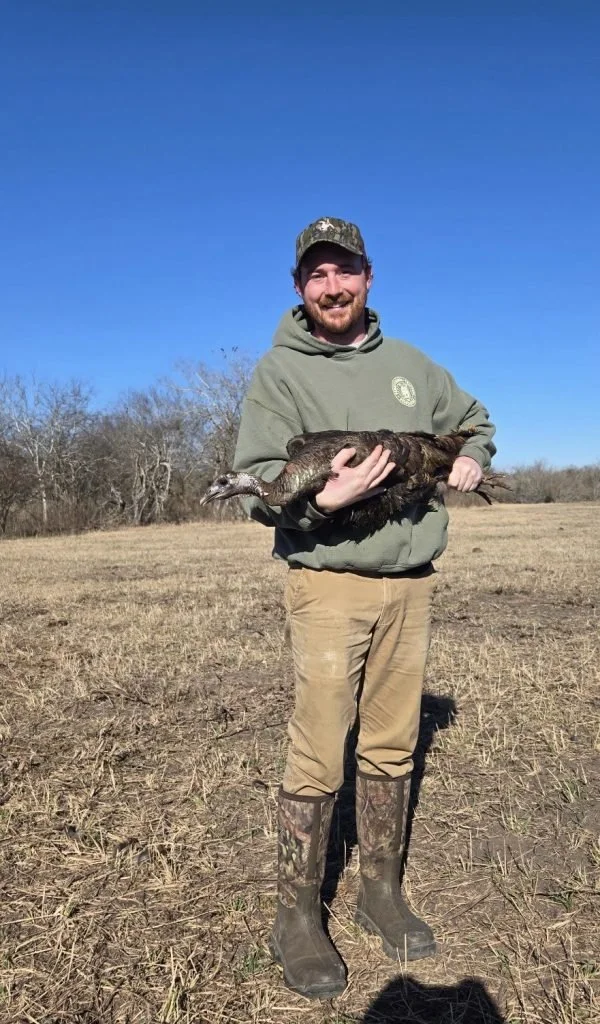
The research project is both collecting new data and utilizing data collected over the past decade on Rio Grande wild turkeys across diverse ecoregions in Texas.
Between 2016 and 2025, more than 700 female Rio Grande wild turkeys were captured and fitted with leg bands and GPS-VHF backpack transmitters using drop-nets and walk-in traps. Currently, there are over 20 birds with active transmitters on the landscape, and project investigators plan to deploy more solar transmitter units this year to collect new data.
“A very cool aspect of this project is that this is one of the longest-running wild turkey data sets in Texas,” said Nicholas Bakner, Ph.D., project lead and postdoctoral researcher at the University of Delaware. “The data was collected from over 775 female wild turkeys by the Texas Parks and Wildlife Department and was only used for a few master’s projects looking at smaller-scale things like precipitation and survival. Looking at resource selection, like what we’re looking to do, has not yet been scratched.”
Using the GPS tracking data and state-specific reproductive timing, Bakner and his team will assign individual females to five seasonal life-cycle stages: pre-laying, laying, incubation, brooding and post-reproduction and then evaluate mortality within each stage. Researchers are curious to see what periods during the female’s life cycle are associated with the highest mortality risk. Project results will help evaluate how landscape characteristics and habitat management practices influence survival during those high-risk periods.
“The idea behind this project is to identify these critical periods and link that to the resources on the landscape,” Bakner said. “We want to identify the critical habitats to make management recommendations that are more fine-scale to the turkey's actual survival, as well as increasing productivity on the landscape.”
This research will allow for the integration of more private landowners in wild turkey habitat management by providing the science behind it.
“It’s so great that the NWTF funded this,” Bakner said. “Without it, we couldn’t get this project off the ground. Rio Grande wild turkeys are a subspecies that are so sought after in Texas. This project is just a steppingstone towards seeing how these populations are doing and what's driving decline in some areas versus what’s supporting survival in others.”
The research team hopes to produce results by winter 2026, followed by statistical analysis of the captured data.
The NWTF invested funds into the above project along with eight other wild turkey research projects across the United States, totaling $503,618, for the organization's 2025 research investment. Since 2022, the NWTF and its partners have combined to put more than $22 million toward wild turkey research.
A Nation United by the Life-Changing Power of the Outdoors.
Accomplishing conservation delivery on a scale necessary to turn the tide of diminishing wild turkey populations is accomplished only through many partners coming together with a focus on common goals. The NWTF helps unite these partners to fight the threats to our ecosystem, including: invasive species, catastrophic wildfire, overcrowded and unhealthy forests, habitat loss due to development, conversion to other uses or successional change. These threats may affect turkey nesting, brood-rearing or roosting habitat, watershed health and winter forage. The NWTF and its allies also continue to advocate for the hunter by searching for more hunter access and monitoring policy discussions across the country.
We are committed to conservation and the pursuit of the great outdoors.
NWTF Initiatives
HABITAT FOR THE HATCH INITIATIVE
Improving forest and field health and resiliency at a landscape scale through active management, specifically enhancing more than 1 million acres of nesting and brooding habitat by 2033. Acres included in Habitat for the Hatch’s 1-million-acre goal are those that specifically establish nesting habitats with quality brood range in close proximity.
[AL, AR, FL, GA, IL, IN, KS, KY, LA, MS, MO, NC, OH, OK, SC, TN, TX, VA]
THE NATIONAL FORESTRY INITIATIVE
A national partnership initiative with Natural Resources Conservation Service focused on improving forest health and forest ecosystems on private lands and managing the forestry-related opportunity derived from the Farm Bill.
[ AR, CO, FL, IA, ID, IN, KY, MN, MO, MS, MT, NE, NC, NH, NY, OH, SC, TN,
TX, VT, WA, WI, WV, WY]
WATERWAYS FOR WILDLIFE
A comprehensive, landscape-level effort to address critically urgent conservation needs in riparian ecosystems along rivers and streams in the Great Plains of the United States.
[CO, KS, MT, ND, NE, NM, OK, SD, TX, WY]
Partner Initiatives
THE SHORTLEAF PINE INITIATIVE
Improving wild turkey habitat and forest health, and the creation and long-term management of pine/oak savannas.
[AL, AR, FL, GA, IL, KY, LA, MD, MO, MS, NC, NJ, OK, SC, TN, TX, VA]
THE WHITE OAK INITIATIVE
Ensuring the long-term sustainability of America’s white oak forests and the economic, social and conservation benefits they create.
[AL, AR, CT, FL, GA, IL, IN, IA, KS, KY, LA, MA, MD, ME, MI, MO, MS, NC, NH,
NJ, NY, OK, RI, SC, TN, TX, VA, VT, WI, WV]
THE LONGLEAF RESTORATION INITIATIVE
Working with federal and state agencies, nonprofit organizations, forest industry and private landowners to restore longleaf pine forests.
[AL, FL, GA, LA, MS, NC, SC, TX, VA]

